

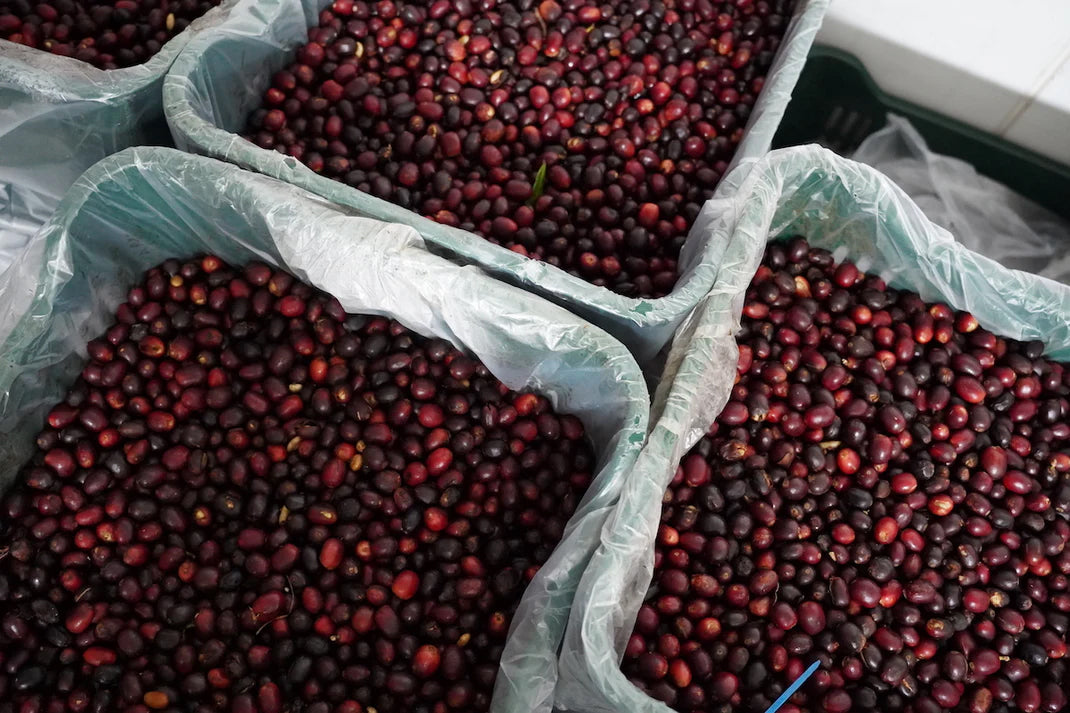
Numerous myths surround coffee: Does espresso really make you more awake than filter coffee? Does coffee dehydrate the body? And is a dark roast automatically stronger? Many of these statements persist – even though they have long been viewed with more nuance scientifically. On this page, we take a closer look at well-known coffee myths, separate facts from half-truths, and explain in an understandable way what actually lies behind them.
Coffee myths at a glance
Is it true that the fresher the coffee, the better?
✗ WRONG
Freshly roasted coffee contains too much CO₂, which is trapped in the bean during roasting. If brewed too early, this gas escapes during extraction and interferes with the result: The coffee tastes flat, restless, or over-aromatic.
Coffee needs a resting period of 4–14 days after the roasting date to develop its full aromatic potential. The sweet spot for most coffees is 1–4 weeks after the roasting date – and after 8 weeks, it noticeably loses freshness.
Conclusion: The roasting date is more important than the purchase date. Freshly roasted ≠ immediately ready to drink.
Does espresso have more caffeine than filter coffee?
- NUANCED
Caffeine levels in roasted coffee and in the beverage are subject to strong fluctuations, as coffee is a natural product. Basically, caffeine is extracted through contact time with water - the longer the brewing time, the more caffeine in the final product.
Is it true that coffee dehydrates the body?
✗ False
No – that's a persistent myth. Coffee is 98% water and cannot dehydrate you. Caffeine also doesn't dehydrate; instead, it stimulates the metabolism. Several cups a day are completely harmless.
Nevertheless, our recommendation: Your daily fluid intake of 2–3 liters should, of course, not consist solely of coffee.
Does a dark roast have more caffeine than a light roast?
✗ False
Caffeine is heat-stable and largely preserved during roasting. Light roasts even have minimally more caffeine per gram because the bean loses less mass. The stronger taste of dark roasts is deceptive.
Are oily, shiny coffee beans a sign of good quality?
✗ Wrong
Oily beans are a sign of over-roasting. Coffee oil emerges from the bean when the cell structure breaks during the second crack – meaning in very dark roasts. The oil on the surface quickly oxidizes, burns during brewing, and creates bitterness.
Practical problem: Oily beans clog grinders – especially in automatic coffee machines. Well-roasted beans are dry and have a matte, even surface. At Wildkaffee, we deliberately never roast to the second crack – not even for our darkest espressos.
Conclusion: Shine = over-roasting. Good beans are dry and matte.
Extra knowledge: In highly fermented coffees, oil emerges much faster during roasting (even if they are roasted as a light roast), where it is not necessarily a negative indicator.
Should coffee be stored in the refrigerator to keep it fresh longer?
✗ Wrong
The refrigerator is one of the worst places for coffee. Coffee absorbs odors and condensation when taken out is harmful. Correct storage: Airtight container, dark, room temperature, never in the refrigerator, always grind fresh.
Extra knowledge: Cafes and coffee enthusiasts freeze coffee at its ideal outgassing point, vacuum-sealed airtight. This way, the peak aroma can be preserved for months. The portion should be fully used after thawing and not refrozen. a negative indicator
Does more coffee grounds automatically make stronger coffee?
✔ Partially Correct
More powder increases concentration – yes. But beyond a certain point, too much coffee grounds leads to over-extraction: The coffee becomes bitter, astringent, and unpleasant. The optimal extraction range is 18–22% of soluble flavors.
"Strength" in coffee comes from the right ratio of coffee amount, water amount, grind size, and brewing time. The brew ratio (e.g., 1:15 for filter coffee) is a better approach than simply using more powder.
Better: Adjust the brew ratio (e.g., from 1:16 to 1:14) instead of uncontrollably adding more powder.
Does Arabica have less caffeine because it's higher quality?
✗ Wrong
The lower caffeine content of Arabica (approx. 1.2%) compared to Robusta (approx. 2.2%) is not a quality characteristic, but a biological adaptation. The coffee plant produces caffeine as a natural defense against insects and pests.
Arabica grows in cooler highlands above 1,000 meters – there are simply fewer pests there, so the plant needs less caffeine for defense. Robusta grows in lower, warmer regions with more pests. Caffeine content and quality are two independent characteristics.
Conclusion: Arabica has less caffeine for evolutionary, not quality, reasons.
Are bad beans dark roasted to hide defects?
- NUANCED
Historically, this was true: industrial roasters masked cheap, inferior beans through strong roasting. Bitter and strong was affordable and mass-marketable. This image still shapes many minds.
Today, this is generally false: Specialty coffee is also dark roasted if the desired profile calls for it – e.g., for a classic chocolatey espresso blend. Cupping experts taste quality under any roast. Poor quality cannot be hidden – it reveals itself in the aftertaste.
Conclusion: Roast level is a stylistic decision, not a quality indicator. Green coffee quality and artisanal roasting are decisive.
Does organic coffee automatically taste better?
- NUANCED
Organic certification guarantees organic farming without synthetic pesticides and fertilizers – an important ethical and ecological achievement. But it is not a promise of taste.
Organic farming can lead to more complex flavors because the plant develops more distinctly in a natural environment. But it doesn't have to. The decisive factors for taste are: variety, origin, processing method and roasting – not the certificate alone. At Wildkaffee, we rely on organic farming out of conviction, not as a marketing tool.
Conclusion: Organic is important – but for environmental and fairness reasons, not as a guarantee of taste.
Does boiling water burn the coffee?
✔ Partially correct
100°C is indeed a bit too hot – ideal is 89–95°C. At 100°C, volatile fruit aromas are destroyed more quickly and bitter notes are extracted more strongly. However, the word "burn" is misleading: coffee does not physically burn due to hot water.
Practical tip: Waiting 30–60 seconds after boiling is completely sufficient and brings the water into the optimal range. Coffee that tastes bitter has, in most cases, been ground incorrectly or extracted for too long – not "burnt" by the brewing water.
Conclusion: Waiting briefly after boiling is good. But the grind size has more influence on bitterness than the temperature.
Does a lot of crema on espresso automatically mean good quality?
- NUANCED
Crema is created by CO₂ from freshly roasted beans – the fresher, the more crema. But very fresh beans are problematic (not yet degassed!). Robusta generally produces more crema than Arabica due to more CO₂ – but not necessarily better espresso. Taste is crucial, not the amount of crema. Conclusion: Crema is a nice aspect of an espresso – but not a reliable indicator of quality.
Is Robusta generally worse than Arabica?
- NUANCED
Historically, much poorer quality Robusta was cultivated and roasted – which still influences its image today. However, high-quality Robusta from India, Uganda, or Vietnam can be aromatic, complex, and very exciting. There are now even R-Graders – quality evaluators specifically for Robusta, analogous to Q-Graders for Arabica.
Robusta has its place: more caffeine, more body, more crema in espresso, more resistant to climate change. The question is not Arabica or Robusta – but quality or no quality. Poor Arabica is worse than good Robusta.
Conclusion: Robusta is not automatically inferior. Quality arises from cultivation, processing, and roasting – not from the variety alone.
Is coffee addictive?
- NUANCED
Caffeine creates a physical habituation, not an addiction in the clinical sense. The body adapts to regular caffeine consumption: if you stop suddenly, you may experience headaches and fatigue – these are withdrawal symptoms, but they subside after 1-3 days.
Unlike genuine addictive substances, caffeine does not lead to a loss of social control, escalating consumption, or severe withdrawal symptoms. The WHO does not classify caffeine as an addictive substance. The morning need for coffee is more of a ritual than a dependency.
Conclusion: Coffee creates habituation, not addiction. If you want to take a break, you should do it slowly to avoid withdrawal headaches.
Should coffee be ground as finely as possible?
✗ Incorrect
The grind size must match the brewing method to properly extract the coffee. If the coffee is ground too coarsely, the taste can become too sour; if it is ground too finely, it can become too bitter. Generally, the longer the brewing time, the coarser the coffee should be ground
Is acidity in coffee bad?
- NUANCED
This is a common misconception: Fruity aromas in coffee are often described as “acidity," but they are not the same as a sour, unpleasant taste. A high-quality Ethiopian coffee might taste of citrus or berries – this is positive, vibrant acidity.
Negative acidity results from underextraction, incorrect water temperature, or poor bean quality. Recognizing the difference takes some practice. If you don't like fruitiness: Medium and dark roasts are the right choice.
Coffee from automatic machines is always worse
✗ Incorrect
This statement is generally incorrect.
The fair comparison: A well-adjusted portafilter machine with fresh specialty beans surpasses a fully automatic machine in precision and aroma control - because the barista controls every parameter themselves. But this requires practice, time, and the right equipment.
For everyday use: A good fully automatic machine with good coffee beats any poorly used portafilter machine.
Conclusion: The fully automatic machine is not the problem - the coffee in it usually is. With freshly ground specialty beans and regular cleaning, it reliably delivers good coffee every day.
Wildkaffee Tip: Our blends Wilderer, Bergsonne, and Wildsau are perfect for consistent extraction in fully automatic machines.
Does coffee get stronger the longer you brew it?
✗ Incorrect
Coffee does not become more concentrated the longer it is brewed; to achieve that, you would need to reduce the coffee-to-water ratio. Coffee brewed for longer can taste "stronger" because more is extracted, often making it more bitter.
Is more expensive coffee always better?
- NUANCED
Not automatically – but a certain premium over supermarket prices is a realistic signal of quality. The global green coffee price is too low to sustainably grow good coffee, pay fair wages, and process it carefully. The mass market is accordingly filled with cheap, low-quality coffee.
Those who pay significantly more than the supermarket price for 100g are buying into a different market: smaller harvests, careful processing, traceable origin. Beyond a certain point, however, the price decouples from the cup: rarity, certifications, and marketing drive it further, without necessarily making it taste better. An €18/100g coffee with a good SCA score can outperform a three times more expensive Geisha prepared poorly.
Conclusion: Cheap coffee is rarely good – but expensive alone is not a guarantee of quality either. The SCA score helps to assess what's in the bag, regardless of price.
Are portafilter machines more expensive than fully automatic machines?
- NUANCED
It depends on the machine, of course, but it doesn't have to be!
Check out our machine recommendations (category purchase decision), but for under 600 Euros you can get a great portafilter setup from Sage, which is cheaper than the automatic machines we recommend from Jura and Delonghi (cheaper automatic machines than that unfortunately don't produce recommendable results)