
How to correctly identify coffee flavor: A beginner's guide to cupping
To truly appreciate coffee flavor, you need more than just good beans: you need a system. This guide leads you clearly and practically through the fundamentals of aromas, a concise cupping guide, and specific exercises for training your palate. This will help you develop a stable coffee flavor profile, identify more precise notes, and consistently assess quality.
Introduction: Why coffee tastes so complex
Coffee is one of the most aromatically diverse beverages in existence. Depending on the variety, origin, processing, and roasting, the flavor profile can range from bright and citrusy to syrupy and sweet, or spicy and deep. The interplay of hundreds of volatile compounds, organic acids , sugar breakdown products, and textural components shapes what we perceive as taste, aroma, and mouthfeel.
At the same time, extraction and perception are sensitive to water composition, grind size, temperature, and time. Those who consciously control these parameters and clearly describe the results learn to reliably differentiate coffee – the basis of every professional tasting (cupping) and the shortcut to greater drinking pleasure.
Chemistry of aromas: volatile compounds, acids, sugars
- Volatile compounds: Roasting produces hundreds of molecules (e.g., esters, aldehydes, pyrazines) that carry fruity, floral, nutty, or chocolatey notes. They primarily determine the aroma perceived in the nose.
- Acids : Citric, malic, tartaric, and sometimes phosphoric acid shape the perceived freshness. Clean, ripe acidity suggests vibrancy; harsh acidity often indicates underextraction or defects.
- Sugar and Maillard reaction: During roasting, sugars caramelize and react with amino acids ( Maillard reaction ) to produce sweet, caramel-like, malty and roasted flavors.
- Lipids and colloids: Oils and fine particles influence body and texture (mouthfeel), for example creamy, syrupy or light.
Influencing factors: Variety, terroir, processing, roasting, water
- Variety: Varieties such as Gesha, SL28 or Bourbon have typical sensory characteristics (e.g. floral elegance vs. fruity richness).
- Terroir: Altitude, climate, soil and shade regulate ripening, sugar content and acid structure .
- Preparation: Washed often brings clarity and citrusy acidity, Natural more fruitiness, Honey a middle ground.
- Roasting: Light roasts highlight acidity and terroir, medium roasts balance sweetness and complexity, dark roasts emphasize bitterness and roasted aromas.
- Water: Minerals control extraction and perception. Too hard can sound dull, too soft thin and acidic.

Correctly describing coffee flavor: taste, aroma, mouthfeel.
Precise language reduces misunderstandings. Distinguish between three levels:
- Taste: sweet, sour, salty, bitter, umami – on tongue and palate.
- Aroma: what you smell – in the cup (aroma) and retronasally when sipping (flavor).
- Mouthfeel (Body/Texture): light, silky, creamy, oily, astringent.
Helpful additional categories: Clarity, balance, resonance (length/quality), complexity, and cleanliness (clean cup). Use specific references: "ripe yellow plum" is more informative than "fruity."
Understanding and using the SCA Flavour Wheel
The SCA Coffee Flavor Wheel leads from general categories (e.g., "fruity") to specific notes ("lemon," "apricot"). Here's how to use it practically:
- Roughly orient yourself: First assign the coffee to a main category (fruity, nutty, floral, chocolatey, spicy).
- Refine: Move outwards and make your definition more specific ("citrus" → "grapefruit").
- Verify: Check plausibility with your aroma library and fellow tasters.
- Document: Keep consistent records of your coffee's flavor profile to ensure it remains comparable.
Cupping for beginners: Step-by-step instructions
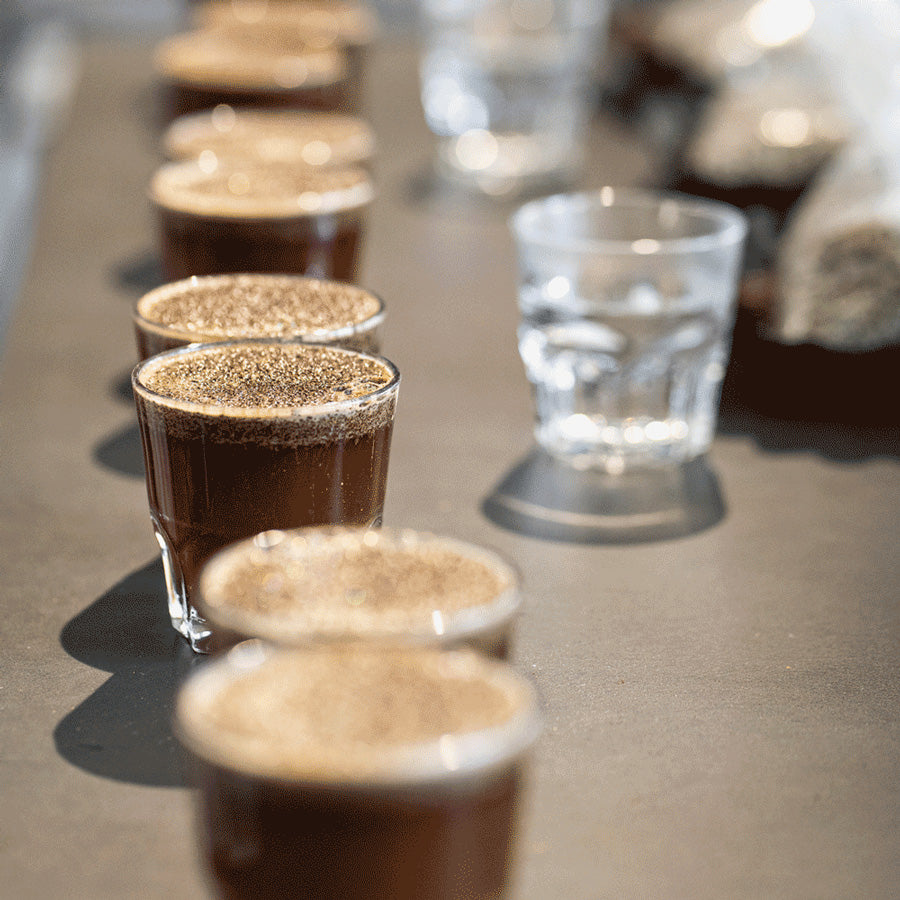
Standardized cupping makes coffees comparable and helps you learn to recognize coffee flavors. The following cupping instructions are based on the common SCA protocol , easily accessible for home and lab use.
Equipment and setup: spoons, bowls, mill, water, ratio
- Identical bowls: 150–200 ml capacity; 2–5 bowls per coffee for consistency.
- Cupping spoon: round, deep spoon for sipping; additionally a cup for scooping.
- Scale and timer: precise dosing and timing.
- Mill: uniform, medium-coarse grind; purge 1–2 g beforehand.
- Water: approx. 93 °C, balanced mineralization (see water recommendation in the FAQ).
- Ratio: SCA standard 8.25 g coffee per 150 ml water (≈55 g/L). For 200 ml cups: approx. 11 g coffee.
Keep the room neutral (no perfumes, strong smells), rinse cups and spoons without odor, and have notepads ready.

Standard protocol: Grind, pour, break crust, slurp
- Weighing and grinding: Grind the planned dose per bowl (medium-coarse, similar to a filter). Note the bean type, roasting date, and grinding date.
- Dry Fragrance: Smell the dry ground material and note your first impressions.
- Pouring: Quickly pour in 93°C water up to the target amount. Start the timer.
- Break the crust (at minute 4:00): Use a spoon to push the floating crust back three times, inhaling deeply and taking in the aroma.
- Skimming: Remove particles and foam cleanly without losing much liquid.
- Slurping (from 8-10 min): When the temperature has dropped, slurp vigorously so that the coffee is distributed in the mouth and aromas become perceptible retronasally.
- Taste multiple times: Check the scores at different temperatures (hot, warm, cool), as the profiles change.
Notes and Scoring: Structured Recording of Tasting Notes
Use a standardized sheet ( e.g., SCA sheet ) or your own matrix. Key fields:
- Aroma/Fragrance, Flavor, Aftertaste, Acidity, Body, Balance
- Uniformity, Clean Cup, Sweetness, Overall
Tips for consistent note-taking:
- From general to specific: "fruity" → "stone fruit" → "yellow plum".
- Distinguish between intensity and quality: "medium-high acidity, ripe, grapey".
- Record comparisons in sentence structure: " Coffee A is sweeter than B; B is clearer than C".
- Short, precise formulations; add for each temperature phase.
Palate training: exercises, comparisons, triangulation
Sensory perception can be trained. Plan regular, short sessions instead of infrequent marathons. Three proven formats:
- Direct comparisons: same bean, two roast levels or processing methods. Specifically note the differences.
- Triangulation: Three cups, two identical, one different – find the "odd cup". Increase the difficulty gradually.
- Calibration: Taste with partners, discuss terms (e.g. "bright and fruity") and compare vocabulary.

Aroma library and everyday training (fruits, nuts, spices)
- Create a set: Citrus (lemon, grapefruit), berries, stone fruit, nuts (hazelnut, almond), spices (cinnamon, clove), flowers (jasmine).
- Practice contrasts: Prepare solutions of sugar, citric acid and table salt, and gradually taste the intensities.
- Smell training: Smell 3-5 samples blindfolded daily, name the terms aloud.
- Transfer to coffee : After the smell training, taste a coffee directly and apply the references.
Identifying common errors and defects
Identifying defects saves time and money. Common off-flavors:
- Phenolic/medicinal: often due to processing; reminiscent of plasters or smoke.
- Fermented/sour: uncontrolled fermentation; vinegar/yogurt notes.
- Musty/moldy: Storage or moisture damage; dull, cardboard-like.
- Rubbery/smoky: Drying or roasting defect.
- Faded/dull: old beans, stored for too long/unfavorably.
- Quaker : unripe beans produce peanutty-dry, shallow cups.
Bitterness vs. astringency, as well as over- and under-extraction
- Bitterness: A taste sensation, often caused by dark roasting or over-extraction. Notes: Cocoa, tonic, bitter almond.
- Astringency: dry, furry mouthfeel (polyphenols), not bitter, but "constricting".
- Underextraction: sharply acidic, thin, short. Remedy: grind finer, brew hotter, extract longer.
- Over-extraction: bitter, woody, empty aftertaste. Remedy: coarser grind, lower temperature, shorter extraction time.
Seasonality and freshness: harvest window and roasting date
Freshness begins at the source: Harvest windows vary depending on the region. After processing and export, green coffee slowly loses volatile components over several months. The roasting date is crucial, but not the only factor: The ideal resting period after roasting is usually 5–14 days (filter), sometimes longer for espresso. Store beans in a cool, dry place, protected from light and air, and open packages only when needed. For comparable cuppings: use the same batch, similar roasting date, and age.
Checklist: Planning your next 10 cuppings
- Define the goal: acid training, preparation comparison, roast level calibration or water experiment.
- Standardize the setup: identical bowls, ratio 55 g/L, 93 °C, timer and notepad.
- Check water: TDS in the range of 75–175 ppm, alkalinity ~40 ppm.
- 3-5 coffees per session: enough variety, but sensorially feasible.
- Incorporate triangulation: one test per session to sharpen perception.
- Cultivate language: Have the SCA aroma wheel ready; note down from coarse to fine.
- Utilize temperatures: Document impressions when hot/warm/cool.
- Calibrate: at least every second session with a partner or team.
- Data backup: Scores, grades, water, mill, bean age – log everything.
- Review: After 10 sessions, evaluate trends and set next learning objectives.
Keep it up: Plan small, regular sessions, document carefully, and consistently use the aroma wheel. With every cup, your confidence grows – along with your enjoyment of the details.